

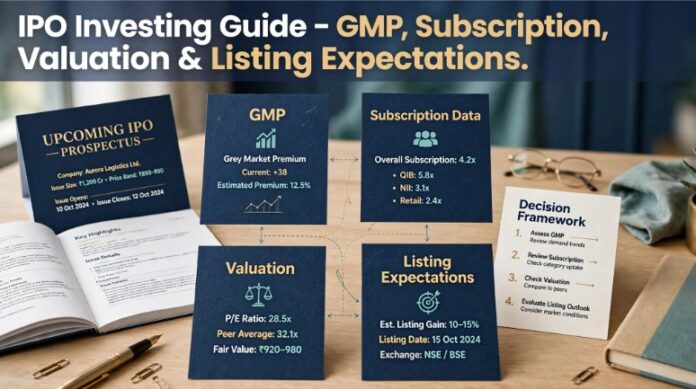
1. Introduction: Why Investors Track the GMP of IPOs
Interest in IPOs tends to spike well before listing day, and right at the center of that pre-listing buzz sits one recurring question: what’s the GMP of IPO shares currently trading at in the informal market? Investors search for this figure constantly, hoping it offers some early clue about whether an offering is worth applying for. And to a real extent, it does — grey market sentiment can genuinely reflect how enthusiastic or hesitant the broader market currently feels about a company going public.
But here’s the central point this entire guide is built around: IPO GMP can provide a useful pre-listing signal, but it should never be treated as a guaranteed listing price or a promise of profit. Before diving into how to track it properly, it’s worth introducing the broader set of factors that deserve equal attention alongside GMP — subscription data, company fundamentals, valuation, and overall market conditions. Together, these give a far more complete picture than any single grey-market number ever could.
2. What Is the GMP of an IPO?
In plain terms, the GMP of IPO shares refers to the unofficial premium — or in some cases, discount — at which those shares are informally traded in the grey market, ahead of the company’s formal stock exchange listing. This grey market operates entirely outside the official exchange system: there’s no regulatory body overseeing these trades, no legal enforcement, and no formal record-keeping. It’s driven by informal dealers and buyers acting purely on expectation.
A premium means buyers are willing to pay more than the issue price, while a discount means the opposite — the market expects the stock to list below its official price. Here’s a simple example:
- IPO issue price = ₹500
- GMP = ₹100
- Indicative Listing Price = ₹500 + ₹100 = ₹600
It’s worth being clear from this point onward: that ₹600 figure is only an indicative estimate, not a confirmed outcome.
3. How Does IPO GMP Work?
At its core, GMP functions through informal buying and selling of the right to receive IPO shares, happening entirely before those shares are officially allotted or listed. This activity is shaped by perceived demand — if a large number of grey-market participants believe an offering will be well-received, more people want in, and the premium rises accordingly.
This creates a fairly direct chain: investor sentiment shapes perceived IPO demand, which shapes the GMP figure, which in turn shapes broader listing expectations. Because sentiment can shift quickly — sometimes based on nothing more than a rumor or a single day’s subscription update — GMP can change several times before listing day, occasionally quite dramatically.
4. Where Can Investors Track IPO GMP?
When tracking an upcoming offering, it helps to look for a complete set of information rather than just a headline GMP figure. Useful data points include:
- Issue price
- Current GMP
- Previous GMP
- GMP trend
- IPO opening and closing dates
- Subscription status
- Listing date
The update time attached to any GMP figure matters enormously — a number from two days ago may no longer reflect current sentiment at all. It’s genuinely worth being cautious of sources that quote a GMP figure without indicating when it was last refreshed. For readers who want a more organized way to track this information, platforms like Malik Times IPO are commonly used to consolidate issue details, subscription trends, and grey market data together, which makes ongoing research considerably more efficient than checking scattered sources.
5. How Is IPO GMP Calculated?
The calculation behind GMP-based estimates is straightforward. It starts with the basic formula:
Indicative Listing Price = IPO Issue Price + GMP
From there, you can calculate the indicative gain:
Indicative Listing Gain % = (GMP ÷ Issue Price) × 100
Here’s a worked example:
- Issue Price: ₹400
- GMP: ₹80
- Indicative Listing Price: ₹480
- Indicative Premium: 20%
It’s worth clearly separating three related but distinct terms here: GMP is the raw, unofficial premium figure; the indicative listing price is simply issue price plus GMP; and the actual listing price is the real, exchange-verified price once the stock genuinely begins trading. Confusing these three is one of the more common mistakes new investors make.
6. What Does a Positive, Zero or Negative GMP Mean?
Positive GMP indicates an unofficial premium is being quoted, which may reflect generally positive market sentiment toward the offering.
Zero GMP indicates little to no premium is currently being placed on the stock, which may suggest relatively neutral sentiment rather than strong conviction either way.
Negative GMP indicates an unofficial discount, potentially pointing toward weaker informal demand or a more cautious market read.
It’s worth stating clearly: none of these three signals independently determines whether an IPO represents good investment quality — each simply reflects a snapshot of current grey-market sentiment.
7. How to Interpret GMP IPO Trends
Rather than fixating on a single reading, it’s far more useful to track how GMP moves over time.
Rising GMP can signal improving demand, generally positive sentiment, strong ongoing subscription, or favorable company-specific news.
Falling GMP can signal weakening demand, broader market volatility, emerging valuation concerns, or shifting investor expectations.
Stable GMP may indicate relatively steady expectations, though this still deserves confirmation from other IPO indicators before drawing firm conclusions.
8. How to Track the Latest IPO GMP Before Listing
Here’s a practical, repeatable process worth following:
Step 1: Check the current GMP and record the latest available figure.
Step 2: Compare previous updates to determine whether GMP is rising, falling, or holding stable.
Step 3: Check the issue price and calculate the resulting indicative listing price.
Step 4: Check subscription data, comparing GMP against both overall and category-wise demand.
Step 5: Review company fundamentals, including financial performance and valuation.
Step 6: Reassess before listing — never assume the earliest GMP reading you saw will remain unchanged right up until the stock actually lists.
Resources such as Malik Times IPO GMP are commonly used by readers specifically to monitor this kind of daily GMP movement and trend across active issues, offering a convenient reference point for staying current on latest IPO GMP figures without manually collecting them from multiple sources.
9. What Factors Influence IPO GMP?
A range of factors typically drive GMP movement:
- IPO subscription demand
- QIB participation
- Retail participation
- Company fundamentals
- IPO valuation
- Sector performance
- Overall stock-market sentiment
- Market volatility
- Company-specific news
- Investor expectations
- Basic supply and demand within the grey market itself
Because GMP is fundamentally sentiment-driven, it can move quickly — sometimes within hours — in response to any combination of these factors.
10. IPO GMP vs IPO Subscription
These two indicators, while related, measure genuinely different things.
| Indicator | What It Shows |
| IPO GMP | Informal pre-listing sentiment |
| Overall subscription | Total investor demand |
| QIB subscription | Institutional demand |
| NII subscription | Non-institutional demand |
| Retail subscription | Retail participation |
| Valuation | Price relative to company fundamentals |
Strong subscription and high GMP can genuinely reinforce each other, painting a consistent picture of enthusiasm — but even when they align perfectly, neither guarantees a profitable listing outcome.
11. Does GMP Predict the Actual IPO Listing Price?
Investors frequently use GMP to estimate potential listing outcomes simply because it’s the earliest available signal. But the actual listing price can differ from this estimate for several reasons: ongoing GMP volatility, changing market conditions, fresh company information, real listing-day demand, and the genuine buying and selling pressure that only emerges once regulated exchange trading actually begins.
The fundamental reason for this gap comes down to structure: the grey market and the official exchange are entirely different mechanisms, with different participants and different rules. To state it plainly: GMP is an estimate of sentiment, not a guaranteed prediction.
12. Is a High GMP Always a Good Sign?
The direct answer is: no. A high GMP may indicate strong short-term excitement, but it doesn’t automatically mean the company has strong fundamentals, that the IPO is fairly valued, that listing gains are guaranteed, or that the stock will perform well over the long term.
Consider this realistic combination: high GMP + high subscription + expensive valuation. This scenario represents genuinely strong demand, but it also carries meaningful valuation risk — a reminder that excitement and value are not the same thing.
13. What Should You Check Alongside GMP?
A broader research checklist worth working through includes:
Company — business model, revenue growth, profit growth, cash flow, and debt levels.
Valuation — P/E, P/B, EV/EBITDA, and comparison against listed peers.
IPO Demand — overall subscription alongside the QIB, NII, and retail breakdown.
Risk — industry risks, regulatory risks, promoter-related risks, customer concentration, and competitive pressure.
14. Common Mistakes When Tracking IPO GMP
Some recurring mistakes investors make include:
- Checking GMP only once, without tracking the trend.
- Ignoring the update date and time.
- Assuming GMP equals the actual listing price.
- Treating GMP as guaranteed profit.
- Applying solely because GMP is high.
- Ignoring IPO valuation entirely.
- Ignoring company fundamentals.
- Confusing grey-market sentiment with official market pricing.
- Relying on unverified social-media GMP claims.
15. Simple GMP of IPO Tracking Checklist
Before Applying
- ☐ Check the IPO issue price
- ☐ Check the latest GMP
- ☐ Compare previous GMP updates
- ☐ Review subscription data
- ☐ Check QIB participation
- ☐ Review company fundamentals
- ☐ Compare valuation with peers
- ☐ Understand major risks
Before Listing
- ☐ Recheck GMP
- ☐ Check whether GMP is rising or falling
- ☐ Review broader market sentiment
- ☐ Reassess listing expectations
- ☐ Avoid assuming GMP guarantees a particular listing price
16. Should Investors Rely on IPO GMP Alone?
Again, the clear answer is: no. GMP is best used as one part of a broader IPO analysis rather than a standalone signal. The more reliable approach combines GMP + Subscription + Fundamentals + Valuation + Market Conditions together. It’s also worth distinguishing between the two different use cases here: GMP is genuinely useful for gauging short-term listing expectations, while fundamentals remain essential for any real long-term investment decision.
17. Final Takeaway
The GMP of IPO shares offers investors a quick, easily accessible read on pre-listing sentiment — useful for understanding IPO GMP Today and spotting whether momentum is building or fading. But it’s worth reinforcing the core distinction one more time: GMP and the actual listing price are not the same thing, and the grey market itself remains entirely unofficial and unregulated.
The most sensible approach, as with any of the pre-listing indicators covered in this space, is straightforward: track the GMP, understand the trend behind it, but make your actual investment decision using the complete IPO picture — not a single grey-market number in isolation.