

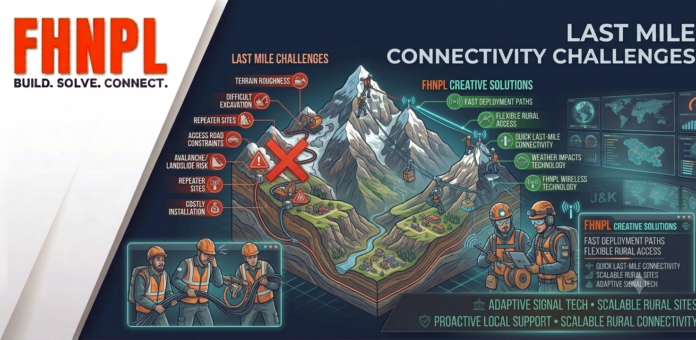
Telecom engineers have a saying: the first ninety-five percent of a network is the easy part. It’s the final stretch — the last mile connecting a fibre point of presence to an actual home or office — that consumes a disproportionate share of the cost, time and difficulty, and nowhere is that truer than in Jammu, Kashmir and Ladakh’s mountain terrain.
Why the Last Mile Is Uniquely Hard Here
A core national or regional fibre backbone can run along relatively accessible highway corridors, but the final connection to a village tucked into a side valley, or a home on a steep hillside, faces obstacles the backbone never encounters — difficult terrain, dispersed households, seasonal weather windows, and the sheer cost of reaching a small number of customers per kilometre of new infrastructure.
Technologies Solving the Last-Mile Problem
Wireless as the Practical Last-Mile Solution
Wireless broadband, delivered from towers backed by dark fibre at strategic points, has become the dominant practical solution for last-mile connectivity across dispersed rural J&K, since it avoids the cost and time of trenching fibre to every individual home while still delivering fibre-grade backhaul reliability. This approach underpins how a Wireless Internet Provider extends coverage economically across a wide, sparsely populated area.
FTTH for Denser or Accessible Routes
Where overhead fibre routes are feasible — along existing utility poles or accessible right-of-way — Fiber-to-the-Home offers a higher-bandwidth last-mile option, typically prioritised for denser clusters, business districts, and institutions with heavier bandwidth needs.
The Economics Behind Last-Mile Decisions
Every last-mile technology choice ultimately balances three factors: the cost of reaching a location, the number of paying customers that location can support, and the bandwidth those customers actually need. This is why the same operator might deploy FTTH in a town centre and wireless broadband in the surrounding villages — not as an inconsistency, but as a rational response to genuinely different economics at each location.
Why Last-Mile Investment Requires a Regional Commitment
Because last-mile economics in dispersed rural areas rarely favour purely profit-maximising decisions, meaningful progress tends to come from operators with a specific regional mission — connecting underserved communities as a core part of their identity, not just an occasional charitable gesture. This is the operating logic behind Fasthook Networks Pvt Ltd‘s continued expansion into villages a purely metro-focused operator might never prioritise.
What Communities Can Do to Accelerate Coverage
Communities without current coverage aren’t entirely dependent on waiting passively — directly requesting a site survey, demonstrating consolidated local demand (a cluster of households, a school, or a local business), and engaging with regional operators actively expanding nearby can meaningfully influence which underserved areas get prioritised next.
Why Persistence Pays Off for Underserved Communities
Operators actively expanding into new districts generally prioritise areas showing clear, consolidated demand over scattered individual requests. A village that organises a joint request — through a panchayat office, school, or local business association — to a Wireless Internet Provider already active nearby typically sees faster results than isolated individual enquiries submitted over time.
Conclusion
Last-mile connectivity remains J&K’s toughest networking challenge precisely because it’s where terrain, economics and infrastructure investment collide most directly. Solving it isn’t a single technological breakthrough away — it’s an ongoing, village-by-village process driven by operators willing to make the harder investment case work.
Frequently Asked Questions
Q: Why is the “last mile” harder than the main network backbone?
A: The last mile involves reaching individual, often dispersed locations across difficult terrain, which is costlier and slower per connected customer than building a core backbone along accessible routes.
Q: Is wireless or fibre better for last-mile connectivity in rural J&K?
A: Wireless, backed by a fibre backhaul, is generally more economical and faster to deploy for dispersed rural areas, while fibre (FTTH) is typically prioritised for denser, more accessible clusters.
Q: Can a village request last-mile connectivity if it currently has none?
A: Yes, residents or local institutions can request a site survey and demonstrate local demand to regional operators actively expanding coverage.
Q: Why do some nearby villages have different connectivity options?
A: Terrain, accessibility and population density vary significantly even between nearby villages, leading operators to choose different last-mile technologies for each.
Q: Does last-mile connectivity investment ever fully “finish”?
A: It’s an ongoing process — as demand grows and infrastructure economics shift, coverage continues expanding into previously unserved areas over time.
Call to Action
Think your area could benefit from expanded last-mile coverage? Request a free site survey to check feasibility. Visit fhnpl.com or follow updates on Facebook, X (Twitter) and Instagram.
Learn more: fhnpl.com | Facebook | X (Twitter) | Instagram