

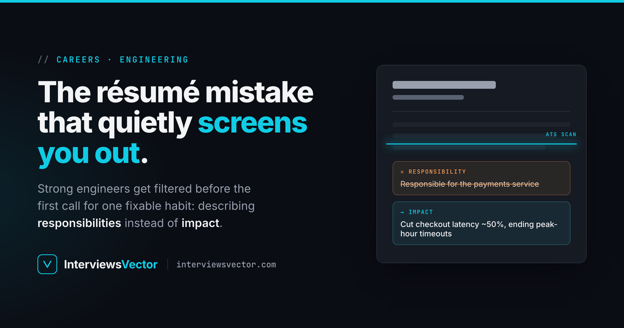
There is a frustrating pattern that plays out constantly among strong, experienced engineers: years of real accomplishment, glowing internal reputation, and a resume that keeps getting screened out before a single conversation happens. The instinct is to blame the market, the applicant-tracking software, or bad luck. Usually the real problem is smaller, more fixable, and entirely within the candidate’s control.
The mistake is this: describing responsibilities instead of impact.
Why “responsible for” quietly kills a resume
Look at how most engineering resumes describe experience and you will see bullet points that read like a job description: “Responsible for the payments service.” “Worked on the checkout redesign.” “Involved in migrating the platform to microservices.”
Every one of those sentences is true, and every one of them is nearly worthless to the person reading it. They describe what the engineer was near, not what changed because they were there. A hiring manager skimming a stack of resumes — and the first pass really is a skim, measured in seconds, not minutes — cannot tell the difference between someone who led that microservices migration and someone who attended the meetings about it.
Senior engineers are especially prone to this, ironically because their work is genuinely complex. The more sophisticated the project, the easier it is to hide behind vague phrasing and assume the reader will infer the significance. They will not. Nobody reading a resume does the work of translating “involved in” into “drove a result.” That translation is the candidate’s job, and skipping it is what gets strong people filtered out.
The fix: scope, action, result
The repair is mechanical once you see it. Every meaningful bullet should answer three questions:
– What was the scope? How large, how critical, how constrained? “A payments service handling the company’s entire transaction volume” tells a reader far more than “a payments service.”
– *What did you do?* Not the team — you. Led, designed, rebuilt, cut, shipped. Claim your specific contribution in a verb the reader cannot misread.
– What changed as a result? This is the part almost everyone omits. Latency dropped, costs fell, an outage class disappeared, a release that took days now takes minutes.
Compare the two versions. “Responsible for improving system performance” versus “Redesigned the caching layer for the checkout service, cutting page-load time roughly in half and removing the most common source of peak-traffic timeouts.” Same underlying work. One reads like a job description; the other reads like a reason to schedule a call.
A word of caution that matters especially for engineers: never invent the numbers. If you do not have a precise figure, describe the direction and magnitude honestly — “roughly halved,” “eliminated the recurring timeout,” “reduced the on-call load noticeably.” A fabricated metric that collapses under one follow-up question in the interview does more damage than an honest qualitative claim.
The habits that compound the problem
Two more patterns sink otherwise strong resumes.
Burying the senior signal. For staff and principal candidates, the most important evidence is often scope and influence — the systems you owned, the decisions you drove, the engineers whose work you shaped — and it frequently gets buried under a list of technologies. A reader deciding whether you operate at the level you are applying for should not have to excavate that signal from the bottom of a bullet.
Optimising for the parser and forgetting the human. Yes, many resumes pass through automated screening first, so clean formatting and relevant terminology matter. But the moment people over-index on keyword-stuffing, they produce a document that satisfies a parser and bores the human on the other side. Both audiences have to be served, and the human is the one who decides.
Get a second read before you send it
The hardest part of fixing a resume is that you cannot see your own vague phrasing — you know what you meant, so the missing impact reads as obvious to you and invisible to everyone else. A structured second pass helps enormously, whether that is a trusted colleague or a tool that flags the weak spots for you. There is now a free resume analyzer built for engineers that checks for exactly these patterns — responsibility-language, missing impact, buried scope — and points out where a reviewer’s eyes will glaze over. And the same goes for the cover letter: if it restates the resume instead of adding context, it is doing nothing.
The takeaway
Experienced engineers rarely get screened out because they lack accomplishments. They get screened out because their resume describes proximity to important work instead of ownership of important outcomes. Fixing that is not a rewrite of your career — it is a rewrite of a dozen sentences. Say what you changed, say it in numbers where you honestly can, and put the senior signal where a five-second skim will catch it. For more on preparing the rest of the process, InterviewsVector covers the interview itself once the resume has done its job of getting you into the room.