

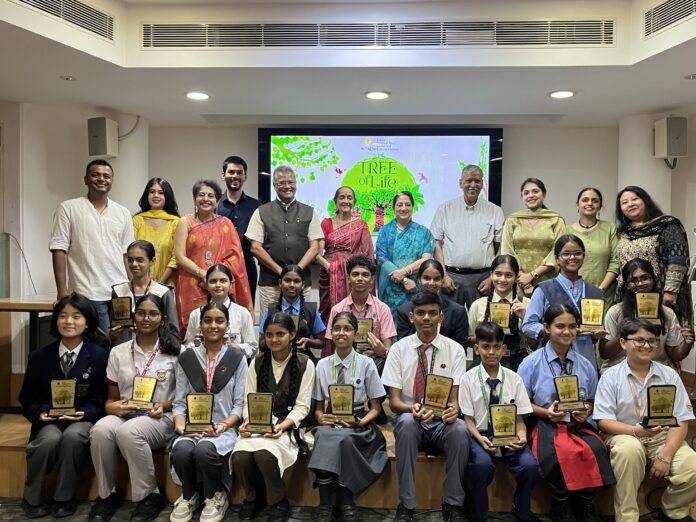
Across India, thousands of young voices came together to celebrate one living idea: heritage grows. Every observation, every sketch, and every story became a reminder that conservation begins long before action, it begins with curiosity.
There is a quiet kind of hope that rarely makes headlines.
It is not found in grand announcements or dramatic moments of change. Instead, it reveals itself in smaller, almost ordinary acts, a child pausing beneath an old tree instead of walking past it, a classroom discussion that continues long after the bell has rung, or a family discovering that the tree growing outside their home has a story stretching back generations.
These moments are easy to overlook because they seem so simple.
Yet history has often shown us that lasting change rarely begins with extraordinary events. It begins when ordinary people start looking at familiar things differently.
That is exactly what happened through Tree of Life.
Across India, thousands of young people accepted what appeared to be a simple invitation: choose a native tree and tell its story. On paper, it was a poster-making competition accompanied by a short essay. In reality, it became something much larger. It became an opportunity for students to rediscover the landscapes they had always lived beside but perhaps never truly noticed.
In doing so, they also rediscovered an idea that has always been central to India’s identity—that heritage is not only inherited through monuments built by human hands, but also through the living ecosystems that have quietly sustained communities for centuries.
At HECS, this belief has always guided the way we approach heritage education.
For us, heritage is not divided between culture and nature. It is one continuous story. A centuries-old temple standing beside a sacred peepal tree. A historic stepwell surrounded by native vegetation.
A village whose identity is shaped as much by its landscape as by its architecture.
These relationships remind us that nature and culture have never existed independently. They have evolved together, influencing one another across generations until they become inseparable.
When we preserve one while overlooking the other, we preserve only half the story.
A National Movement Rooted in Curiosity
India’s greatest strength has always been its extraordinary diversity.
Every region has its own language, traditions, architecture, food, festivals and landscapes. Yet beneath all these differences lies something remarkably consistent, a deep relationship between communities and the natural world around them.
Tree of Life celebrated this relationship on a national scale.
Through 95 INTACH Chapters and young INTACH Heritage Clubs, students from Classes VII to IX across the country were invited to identify an indigenous tree, shrub or plant from their own surroundings and explore its ecological, cultural and historical significance. What followed exceeded every expectation.
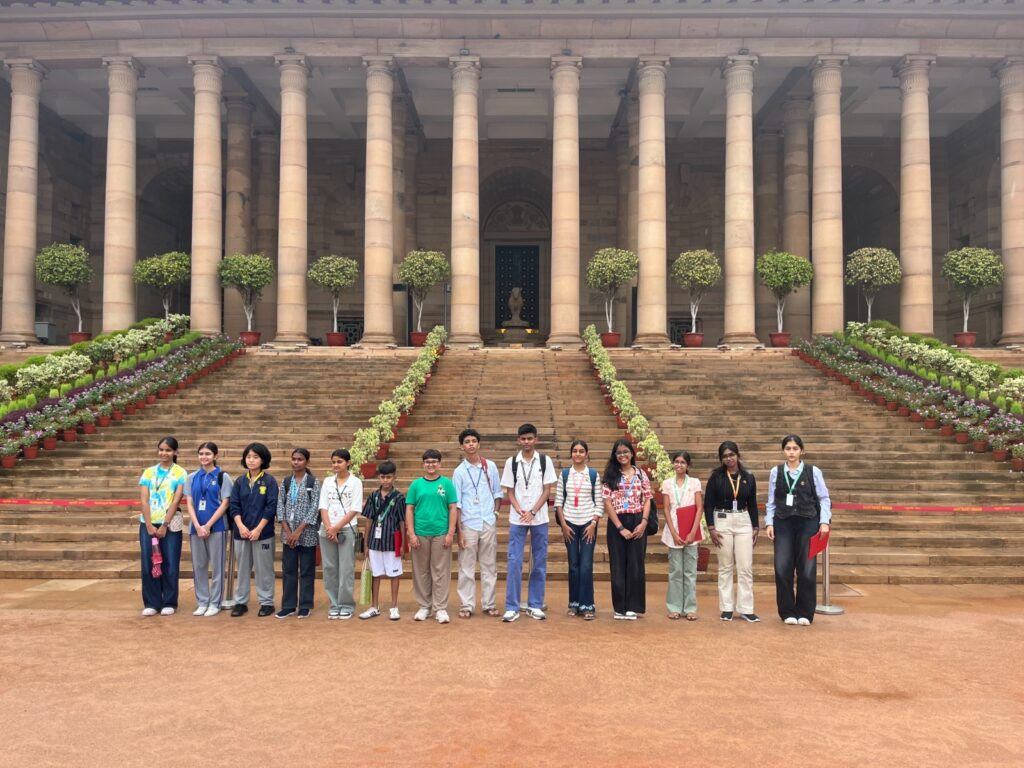
More than 12,000 students participated in the initiative, documenting native species through carefully researched posters and essays, while 15 National Winners and 106 Regional Winners were recognised for their exceptional work.
Some students walked through neighbourhood parks with notebooks in hand. Others spoke to grandparents about trees that had quietly become part of family memories. Many discovered that birds, butterflies and insects they had never paid attention to depended entirely upon native species growing nearby.
Every student began with the same assignment. Yet every student discovered a different story.
Collectively, those stories formed something far greater than a competition.
Beyond Numbers
In today’s world, numbers often become the easiest way to measure success.
We count participants. We count winners. We count certificates distributed.
These statistics certainly matter because they demonstrate scale and impact.
Yet some achievements cannot be measured so easily.
What does 12,000 truly represent?
It represents 12,000 moments when curiosity overcame indifference. It represents 12,000 children who chose to pause instead of rushing past something familiar.
It represents thousands of conversations between students and teachers, children and grandparents, families and communities.
It represents thousands of questions.
“What tree is this?”
“Why has it always grown here?”
“Which birds depend on it?”
“Why do people consider it sacred?”
“What happens if it disappears?”
Every question expanded a child’s understanding of the world around them.
Education often celebrates the ability to produce correct answers.
Tree of Life celebrated something equally valuable, the willingness to ask meaningful questions.
Because curiosity has always been the first step towards knowledge.
And knowledge has always been the foundation of conservation.
Growing Future Conservationists
Environmental conservation is frequently discussed in terms of technology, legislation and policy.
These are undoubtedly important. But before any policy can succeed, society itself must recognise what deserves protection.
People rarely protect what they fail to notice.
This is perhaps the greatest lesson that Tree of Life offers. Conservation does not begin with planting a tree.
It begins much earlier. It begins when someone recognises the importance of the tree that already exists.
Young people are uniquely capable of developing this understanding because curiosity comes naturally to them. When given meaningful opportunities to observe, explore and create, they do far more than complete an assignment. They begin building relationships with the landscapes around them.
A student who has spent hours documenting a native tree is unlikely to see it as just another part of the roadside. A child who has learnt how many birds depend upon a particular species is far more likely to value biodiversity in the future.
The Role of HECS
Heritage Education and Communication Services has long believed that education should extend beyond preserving knowledge. It should cultivate perspective.
For this reason, our programmes consistently encourage learners to engage directly with the places they inhabit, recognising that genuine understanding emerges not only through reading but through observation, participation and dialogue.
Tree of Life reflects this philosophy in its simplest form.
By asking students to document a native tree rather than merely describe one, the initiative transformed heritage from an abstract concept into a personal experience.
At the same time, the initiative gently expanded a widely held understanding of heritage itself.
For generations, monuments have rightly occupied a central place within heritage conservation. They continue to inspire admiration, scholarship and preservation efforts across the country.
Yet India’s identity has never been built by architecture alone.
Its rivers have shaped settlements. Its forests have supported livelihoods.
To separate natural heritage from cultural heritage is to divide a story that has always been whole.
At HECS, we believe both deserve equal care because together they define who we are.
Why These Stories Must Be Shared
Every successful educational initiative creates two kinds of impact.
The first is experienced by those who participate directly.
The second emerges when those experiences are shared with others.
This is why communication forms such an important part of conservation. When stories travel, ideas travel with them.
A teacher reading about Tree of Life may decide to organise a similar activity within their own school.
Parents may begin encouraging children to identify native species growing around their neighbourhood. Communities may start recognising trees not simply as elements of the landscape but as valuable parts of their shared heritage.
Thoughtful public communication therefore extends the life of a programme far beyond its official duration.
In many ways, every conversation generated by Tree of Life becomes another seed planted for the future.
A Forest Begins With a Single Seed
The true legacy of Tree of Life cannot be measured by the number of posters submitted or awards distributed.
Its legacy lies in the way thousands of young people now look at the world around them. Some will become architects. Some will become scientists.
Some will become artists, teachers, entrepreneurs or policymakers.
Many may never work professionally in conservation.
Yet all of them will carry forward one invaluable lesson, that heritage is alive.
If today’s children recognise living heritage, tomorrow they will protect it.
That is why every poster created through Tree of Life represents far more than artistic expression.
It represents hope. Because every great forest begins with a single seed.
And every enduring conservation movement begins with a generation willing to notice the living heritage growing quietly around them.