

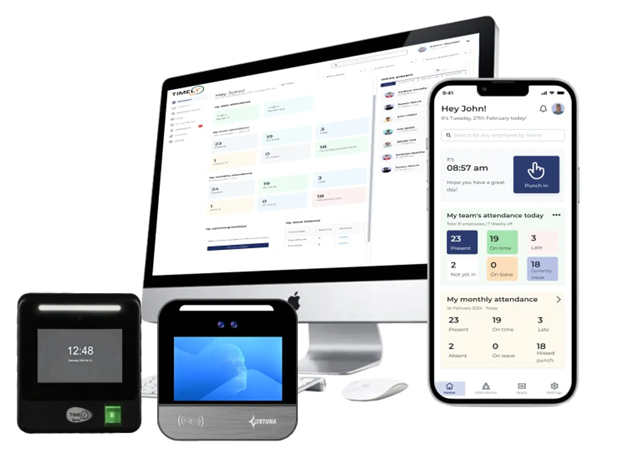
Fortuna, the Kolkata-based company that put biometric systems inside 20,000+ offices and mission-critical infrastructure, has turned its engineering muscle toward a very different customer: the now booming startups and MSME ecosystem.
For three decades, Fortuna has been the quiet infrastructure behind India’s largest organizations. Their face recognition and fingerprint terminals sit at the gates of defence facilities. Their software logs attendance for hundreds of thousands of workers daily. They pioneered push technology in biometrics — one of the first worldwide — in 2008.
None of that is what makes their newest product interesting.
What’s interesting is that Fortuna chose to rebuild their product category from scratch for small businesses. Not downsized. Not repackaged. Rebuilt. The result is timely.bio. And it may be the most consequential thing the company has ever shipped.
The problem nobody wanted to admit
Walk into any 15-to-50 person business in India today and ask how they track attendance. You’ll find one of three answers: an Excel sheet someone dreads updating, an ageing fingerprint device breaking down since 2019 with no one to call, or nothing at all.
The irony is that enterprise-grade biometric systems have existed in India for decades. The technology works. The problem was never the technology.
“Enterprise attendance systems assume you have a dedicated IT admin, a six-week onboarding window, and someone to call when things break,” says the Fortuna team. “Small businesses have none of that.”
Software vendors kept building for enterprise buyers — more features, more configuration, more complexity — while millions of MSMEs were without a workforce management system that needed an IT Administrator.
Phones mounted to walls — the limits of “Jugaad”
Into this gap stepped a wave of vendors with a solution that looked clever: mount a mobile phone or a tablet on the wall, run a face recognition app, and call it an AI attendance system.
Fortuna has a word for it: “Jugaad” (a hack).
The critique is technical, not rhetorical. A smartphone camera captures a 2D image. It cannot distinguish between a photograph, a video on another phone, and a real human face. In controlled tests — and real-world deployments — these systems can be fooled by holding up a photo or video of an employee as they can’t distinguish between 2D and 3D images. Preventing this requires purpose-built hardware: dual cameras, infrared sensing, binocular depth analysis. These are not components found in a consumer smartphone.
“Companies have spent significant marketing budgets convincing customers that this is the next big thing,” Fortuna’s team notes. Their position: the next big thing is hardware and software working together as one system, purpose-engineered to solve real problems — not assembled from off-the-shelf consumer parts.
Go live in under an hour. No IT team needed.
timely.bio‘s pitch is simple: full deployment in under one hour. Employee enrollment in under 30 seconds per person.
Enterprise attendance systems typically require days of on-site setup, server configuration, and IT admin handholding before the first punch is logged. timely.bio’s claim is that an owner can unbox the hardware, connect to WiFi, create the company account, and have their team punching in before lunch.
The key architectural decision behind this: hardware, software, and mobile app all built in-house, by the same team, for the same customer. Fortuna designs the device. Fortuna built the cloud platform. Fortuna made the app. When things connect immediately, it’s because they were designed to.
Most competitors in the MSME segment resell third-party hardware wired to third-party software stitched together by a channel partner. When something breaks, nobody owns it. timely.bio has one accountability point.
The employee self-service difference
The dominant model in attendance software is administrator-centric: one login for the HR manager, who controls everything on behalf of everyone else. Employees clock in, clock out, and wait for someone else to work on applications like leaves and Regularizations.
While ESS is a paid module on some apps, Fortuna took the other route. timely.bio gives every employee their own login from day one. Right out of the box, employees can apply for leave from their phone, view their records, and raise regularization requests — all routed through an approval workflow to their manager.
The business owner sees the whole organization. The manager sees their direct reports. The employee sees their own data only.
“Founders and owners in MSMEs are always squeezed for bandwidth. We chose to give ESS out of the box even on our base pack to ensure the system just works — not add overhead,” says Ashmit Bhandari, on behalf ofnthe Fortuna team.
Four modules. One platform. No separate systems.
The core is attendance — AI face recognition via a wall-mounted biometric terminal, or geo-fenced mobile selfie for field staff. Both feed into the same dashboard. Sub 1 second face recognition, liveness detection that can’t be fooled by a photograph, and offline capability on biometric terminals that stores every punch locally and syncs when connectivity returns.
Access control is built into the same device. One terminal controls the door, logs the entry, calculates time spent away from a workstation, and syncs to the dashboard. No separate access panel. No secondary software license.
Live location tracking targets a pain point that has cost MSME owners real money: field staff with no accountability. GPS streams to the manager automatically at punch-in. Meetings are verified by GPS trail. The system computes actual distance travelled — directly cutting fuel reimbursement inflation, a problem so endemic in Indian field sales it’s become a line item in most CFO conversations.
Visitor management rounds out the suite. Digital badges with QR codes, host approval via mobile alert, pre-registered visitor flows, full visit logs exportable for compliance or audit — on any tablet, phone, or browser. No extra hardware.
This is a workforce management platform that would have cost an enterprise buyer multiple vendor relationships and a significant integration budget five years ago. timely.bio has packaged it for any team under 200 people.
What this means for the market
India has approximately 63 million MSMEs. The vast majority have never used a structured, digital attendance system. The market is not underpenetrated — it is barely entered.
Solving deployment complexity is the unlock. Every attendance vendor has known this. Very few have been willing to rebuild their product architecture to fix it, because doing so means cannibalising an enterprise sales motion that works.
Fortuna had the discipline to build timely.bio as a separate product entirely — not a simplified version of their enterprise stack. The result is a system that doesn’t ask a small business owner to understand biometric architecture. It just works.
In a category defined by friction, that is the entire product.
timely.bio is available on Web, iOS, and Android. Fortuna Impex Pvt Ltd is headquartered in Kolkata and has been building biometric systems in India since 1996.