


Food has always been more than nourishment in India. It is emotion, memory, identity, and connection. It brings families together, comforts people after long days, and carries the warmth of tradition across generations. Yet in today’s world, one of the biggest lifestyle challenges for millions of people is simple: finding time for the kind of food they truly want to eat.
Modern schedules have changed how people live. Working professionals manage deadlines, calls, travel, and long commutes. Students balance academics, pressure, and irregular routines. Young parents are constantly navigating responsibilities at home and work. Individuals living away from family often struggle to recreate the taste and comfort they grew up with.
As life becomes faster, food decisions become harder.
Many people want wholesome Indian meals, but daily cooking is not always realistic. Ordering from outside every day can become expensive, repetitive, and often unhealthy. Instant foods may be convenient, but many fail to satisfy either nutritionally or emotionally. This has created a strong demand for something people can truly rely on — food that is quick, trustworthy, satisfying, and familiar.
That is where Ziply5 is creating a meaningful place for itself.
Led by Siddhardha Nallamothu, Managing Director of Ziply5, the brand is building more than a ready-to-eat food range. It is building trust around one of the most personal aspects of life — what people feed themselves and their families.
Trust in food is not earned through advertising alone. It is earned through consistency, quality, transparency, and experience. Consumers may try a product once because of curiosity, but they only buy again if it delivers confidence. This is especially true for ready-to-eat meals, where the stakes are higher because people are looking for routine use, not occasional novelty.
Ziply5 appears to understand this deeply. Its product approach focuses on preservative-free meals, no added MSG, no artificial colors, and recipes inspired by real Indian culinary preferences. In a market crowded with convenience claims, this kind of clarity matters.
Families today are more label-conscious than ever. They read ingredients, compare brands, and ask whether convenience is coming at the cost of health. They want options that save time without creating guilt. Ziply5’s positioning directly speaks to that consumer mindset.
But trust is not built only through ingredients. It is also built through taste.
No matter how clean the label is, people return only when food feels enjoyable and familiar. This is where Indian meal brands face a unique challenge. Indian cuisine is rich, layered, regional, and emotionally charged. Consumers can immediately recognize when flavors feel artificial or generic.
Ziply5’s meal portfolio reflects a stronger understanding of this reality. Offerings like Veg Biryani, Chicken Biryani, Pongal, Semiya Upma, Sambar Rice, Prawn Biryani, and Palak Chicken Rice are dishes rooted in actual food habits, not trend-chasing concepts. These are meals people already know, love, and crave.
That matters because convenience succeeds faster when it preserves familiarity.
For working professionals, this means returning home late and still enjoying a satisfying hot meal in minutes. For students, it means reliable food without depending on expensive takeout. For parents, it means saving time while still serving something closer to home-style preferences. For those abroad or living away from home, it means reconnecting with taste memories instantly.
In all these situations, Ziply5 becomes more than food — it becomes reassurance.
This emotional layer is powerful in brand building. Products that solve functional problems may grow. Products that solve emotional problems often become loved brands.
Ziply5 also benefits from timing. India is seeing a rapid rise in convenience consumption, but consumers are becoming more selective. Earlier, speed alone was enough. Today, speed plus quality is the expectation. Tomorrow, speed plus quality plus trust will define category leaders.
Brands that move early into this evolved expectation gain significant long-term advantage. Ziply5 is positioning itself in exactly that premium trust space.
Another reason the brand has growth potential is versatility. It appeals across multiple consumer segments simultaneously. Urban professionals need speed. Families need reliability. Students need affordability and convenience. Travelers need portability. NRIs need authentic Indian flavors. Retailers need repeat-demand products.
Few brands successfully align with so many audiences through one category.
Beyond households, Ziply5 is also strengthening its presence in the HORECA segment — serving hotels, restaurants, cafés, and catering businesses that face constant operational pressure. These establishments often struggle with rising labor costs, inconsistent output during peak hours, food wastage, and maintaining authentic taste across multiple service cycles.
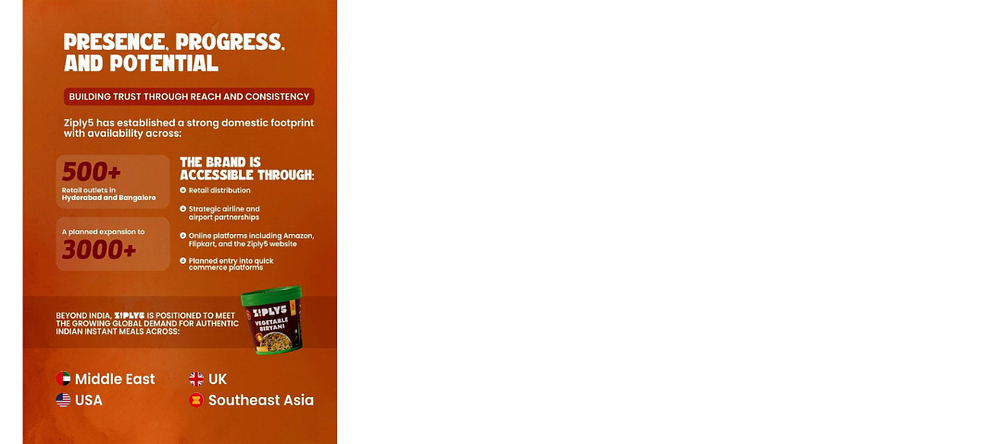
Ziply5’s ready-to-eat meals, which can be prepared within 3–5 minutes using minimal heating or hot water, provide a reliable and scalable solution. Restaurants can expand their menus without relying heavily on skilled chefs. Hotels can enhance breakfast spreads and in-room dining options. Catering services can manage large-scale events with better efficiency and consistency. Buffets benefit from faster replenishment, improved portion control, and reduced wastage.
This makes Ziply5 not just a consumer brand, but a dependable operational partner for food businesses seeking to balance speed, hygiene, cost-efficiency, and authentic taste.
From a founder-story perspective, Ziply5 also carries credibility. Siddhardha Nallamothu’s stated inspiration from his mother’s kitchen gives the brand emotional authenticity. Consumers increasingly value brands built from real experiences rather than artificial marketing stories. When founders solve problems they personally understand, products tend to resonate more naturally.
This kind of founder connection often influences everything — from recipe choices to quality standards to customer empathy.
The larger significance of Ziply5 lies in what it represents for Indian consumers. It signals that packaged food in India does not need to imitate western convenience models. It can be proudly Indian, rooted in real recipes, and designed for modern life. It can respect both time and tradition.
That is a powerful shift.
India’s food market is evolving from low-trust convenience to high-trust convenience. Consumers no longer ask only, “How fast is it?” They now ask:
Will I enjoy it?
Can I trust it?
Will I buy it again?
Can I serve it to my family?
Ziply5 appears to be building answers to all four questions.
Looking ahead, the brand has room to grow beyond current products. Once trust is established, consumers often welcome adjacent categories — breakfast solutions, regional specialties, healthier variants, travel packs, festive lines, subscription bundles, and export-ready formats.
That means today’s meal brand could become tomorrow’s broader food platform.
In the end, great consumer brands are built when they become part of everyday life. They are remembered not because they were flashy, but because they were dependable. They fit naturally into routines. They reduced stress. They delivered satisfaction repeatedly.
Ziply5 is steadily building that kind of relationship.
For households, professionals, students, and families navigating busy lives, a dependable meal is more valuable than ever. If Ziply5 continues on its current path of quality, authenticity, and trust, it could become one of the most respected names in India’s ready-to-eat food future.
To explore the growing range of authentic meal solutions, visit https://www.ziply5.com/ and discover convenience that feels like home.
Products are available on Ziply5 website and Amazon