

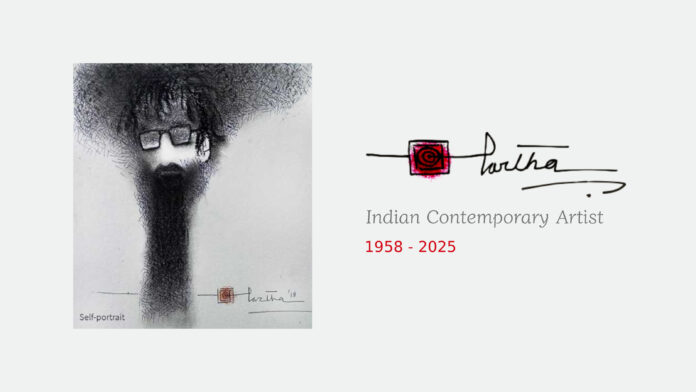
In 2017, a cerebral attack stole much of Partha Bhattacharjee’s vision. The peripheral sight was damaged. The ability to hold a single point in focus — the bedrock of an oil painter’s practice — became unreliable. He had spent more than 35 years building a body of work in oil on canvas that required precisely this: clear eyes, steady focus, the capacity to render a silk sari in photographic detail, a face in the subtlest gradations of shadow and light.
Most people, facing this, would have stopped painting.
Partha Bhattacharjee changed his medium and kept going.
The Shift From Oil to Pastel
Dry pastels behave differently from oil in ways that turned out to matter enormously. They are immediate. They reward instinct and urgency over calculation and patience. A colour pressed, a line drawn, a form emerging in minutes rather than the weeks that oil glazes required. For an artist whose hands still carried forty years of muscle memory but whose eyes could no longer sustain precision, this immediacy was not a compromise. It was, gradually and then suddenly, a liberation.
He moved from canvas to paper. He brought mixed media alongside the pastels. And — most significantly — he turned with complete urgency toward the folk traditions he had spent decades absorbing in the remotest villages of India. The Madhubani outlines absorbed in the villages surrounding Shantiniketan. The Warli geometry absorbed in Maharashtra. The Gond patterning and the Bengal Patachitra scroll traditions he had learned by watching and listening in places most trained artists never go.
These traditions, held inside him for years as deposits of accumulated attention, now poured out onto paper with the directness and warmth of someone who has internalized a language so thoroughly that they no longer need to think about grammar to speak it fluently.
The Series That Emerged
The Companion Series, Migrant Worker Series, Mahakal Series and Rural Series — all produced in these final years — are among the most deeply felt works of his entire career. The Companion Series is intimate: two figures, an animal, a tree — the small, unspectacular dignities of village life rendered with the warmth of someone who has actually spent time there, who knows what it looks, feels, and smells like. The Migrant Worker Series carries a different weight entirely — the specific sadness of people who have left the place that made them for a city that does not quite claim them.
The Rural Series is the most comprehensive. Here, all the folk languages Partha had spent years learning — Madhubani, Warli, Gond, Patachitra — come together not as pastiche or reproduction but as something new: one artist’s synthesis of India’s oldest visual traditions into a voice that is unmistakably his own.
What the Hands Remember
There is something important to understand about these late works: every stroke was laid by a man whose eyes were unreliable, whose peripheral vision was damaged, who could not always trust what his eyes were reporting to his hands. And yet the paintings do not show any of this. They glow with conviction. The lines are bold precisely because they had to be. When you cannot rely on fine detail, you paint with the authority of someone who has internalized the world so completely they no longer need to look at it directly. Partha painted from inside forty years of looking.
He said once: “I believe in a very simple philosophy of life. If I am honest and true to my art, I will reach the divine. This is the only form of prayer.” After 2017, with his vision damaged and his time running shorter than any of them knew, he remained exactly that: honest and true. Painting as prayer. Canvas — or paper, by now — as the only altar he had ever needed.
The artist Partha Bhattacharjee died in 2025. What he left behind is not merely a body of work but evidence of what the human spirit does when the lights dim: it finds another way to see. Collectors and admirers can explore Partha’s fine art from India — works made in these final years with compromised eyes and an entirely uncompromised soul.